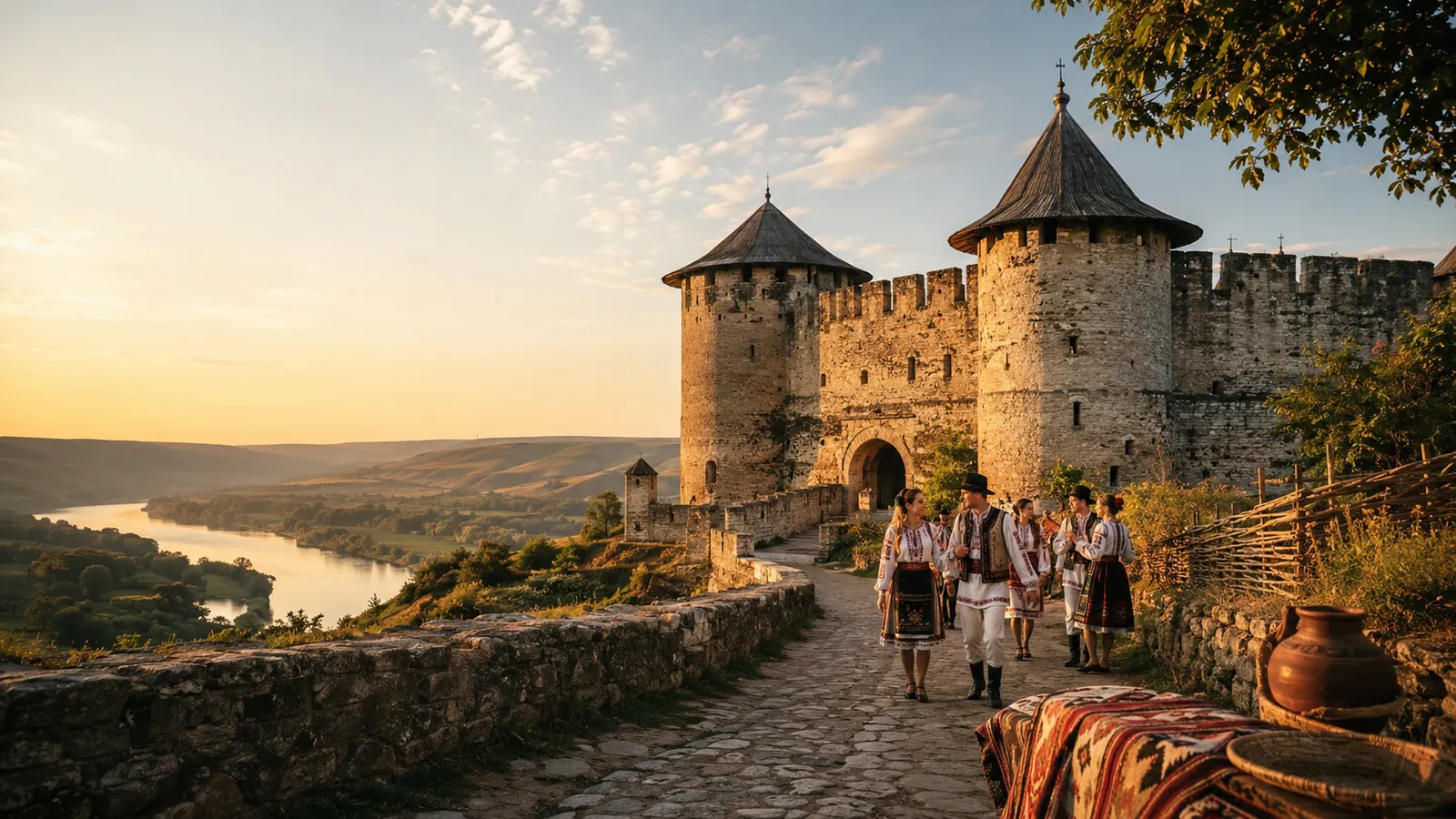
Traditions and culture
Mărțișor tokens on 1 March, carols and masked plays in winter, rugs woven on the loom and weddings that run for several days. Many of these are still practised, and not only in museums.
Moldova’s identity lives in the customs, crafts and festivals passed down from one generation to the next. From Mărțișor to the village patron-saint feasts, from woven rugs and wheel-thrown pottery to the hora and lăutar music, each element tells something about the character of this country and the hospitality of its people.
Festivals & holidays
5Mărțișor (the spring token of 1 March)
1 MarchThe custom of 1 March, when people give one another small ornaments braided from white and red threads, a symbol of the arrival of spring. The Mărțișor is included in the intangible cultural heritage of humanity (UNESCO), together with other countries of the region.
DetailsThe Winter Holidays
December – JanuaryA period rich in customs: carolling from house to house, the good-wishing rounds of the Plugușor and the Sorcova, masked plays (Malanca, the Goat, the Bear). The winter holidays preserve rituals hundreds of years old.
DetailsEaster
Spring (Orthodox calendar)The most important Orthodox celebration in Moldova. The preparations include pasca, cozonac and red eggs, and the Resurrection service gathers the community at church. It is a celebration of family and of renewal.
DetailsHramul satului (the village patron saint's day)
Variable (the church's day)Every village and church has its hram — the feast day dedicated to the patron saint. It is an occasion for a shared meal, music, dance and hospitality, when the village receives its guests with open arms.
DetailsNational Wine Day
The first weekend of OctoberMoldova's most important festival, held every year on the first weekend of October in the centre of Chișinău. Dozens of wineries present their wines, alongside gastronomy, music and crafts — a celebration of the country's winemaking identity.
DetailsCustoms & traditions
3Moldovan hospitality
All year roundOne of the best-known traits of Moldovans. The guest is welcomed with bread, salt and a glass of wine, and the table — always abundant — is considered sacred. Hospitality is part of the country's deep identity.
DetailsThe traditional wedding
Family eventThe Moldovan wedding is a famous event, which can last several days. It preserves old customs — the preparation of the dowry, the bride's dance, the gift-giving — and gathers whole families in a celebration of joy and of community.
DetailsCumetria (the christening feast)
At a baptismCumetria is the celebration connected with a child's baptism, an important social event in which the godparents play a central role. It strengthens the ties of spiritual kinship and of community, marked by a feast, gifts and good cheer.
DetailsMusic & dance
3Hora (the circle dance)
At celebrations and weddingsThe hora is the emblematic folk dance, danced in a circle with dancers holding hands — a symbol of unity and communal joy. There is no celebration, wedding or hram without a hora.
DetailsDoina (traditional lyrical song)
Traditional lyrical songThe doina is a traditional lyrical song, an expression of longing and of inner feeling. Its free and melancholy melodies form part of the musical treasury of the Romanian lands.
DetailsMuzica lăutărească (the music of the lăutari)
At parties and weddingsMuzica lăutărească, performed by tarafuri, accompanies parties, weddings and celebrations. The violin, the cimbalom, the pan flute and the accordion create music full of soul and virtuosity, part of Moldova's identity.
DetailsCrafts
3Traditional pottery
Living craftPottery is a living craft in Moldova, preserved in villages with a tradition of it such as Hoginești and Iurceni. Clay vessels and objects, worked by hand on the wheel and fired in traditional kilns, continue an art centuries old.
DetailsScoarțe (traditional woven wall carpets)
Living craftThe art of weaving scoarțe — wall carpets with traditional motifs and symbols — is an emblematic craft. The techniques for making the scoarță are inscribed on the UNESCO intangible cultural heritage list, jointly with Romania.
DetailsWoodworking
A living craftWood carving and woodworking decorate gates, furniture and household objects with folk motifs. A rural craft passed down from father to son, combining the useful with the beautiful.
DetailsThe people of culture
Makers of culture
The writers and musicians who gave a voice to Moldovan identity.
Crafts that are still practised
A few villages still live by skilled hands. At Hoginești and Iurceni, pottery is thrown on the wheel and fired in clay kilns; the vessels made here are sold across the country. Better known internationally are the scoarțe — hand-woven wall rugs with geometric and floral motifs. The technique of making a scoarță was inscribed on the UNESCO intangible heritage list in 2016, jointly with Romania.
Folk dress is just as alive. The cămașa cu altiță — the blouse embroidered at the shoulder with a distinctive pattern — was likewise recognised by UNESCO in 2022, again jointly with Romania. It comes out for holidays, patron-saint feasts and weddings, events that in Moldovan villages can run for several days.
Frequently asked questions
Questions about Moldova’s traditions
What is Mărțișor?
A custom on 1 March, when people give one another red-and-white tokens as a symbol of spring. It is inscribed on the UNESCO intangible cultural heritage list.
What are the most important holidays in Moldova?
Easter, the winter holidays (with carols and masked plays such as Malanca), the village patron-saint feasts and the National Wine Day.
What traditional crafts exist in Moldova?
Pottery, the weaving of scoarțe — wall rugs inscribed on the UNESCO heritage list — and woodworking.
What is a traditional Moldovan wedding like?
It is an event that can last several days, with its own customs (the dowry, the bride’s dance), lăutar music, dancing and abundant tables.
What is distinctive about Moldovan hospitality?
A guest is received with bread, salt and a glass of wine, and the table is held to be sacred — the generosity of Moldovans is proverbial.
Where to stay for feasts and festivals
For patron-saint feasts and festivals, book accommodation early. Compare the options on the map.
Map provided by Stay22. Bookings are completed on the partner platforms.
Where to taste it
Where to eat
Restaurants in Chișinău, from traditional kitchens to modern rooms.
SeeWineries & tastings
From record-breaking underground cities to family wineries. Almost all of them take visitors by appointment.
SeeWhere to stay
Real hotels and guesthouses, with prices compared on the map across Booking, Airbnb and other platforms.
SeeExperience the traditions first-hand
Visits to traditional villages, taking part in local customs, meals with authentic dishes.