Chișinău is not a city where the good restaurants gather in one district. They are scattered, and the difference between areas has less to do with quality than with type: where you eat lunch between two sights, where you sit down for three hours in the evening, where you get a properly made coffee.
Our directory lists 23 restaurants in Chișinău. This article is not a list of them — it is the mental map you need in order to know which area to look in, depending on what you want to do that day.
How the city is divided
Chișinău is organised into sectors, and for a visitor four areas really matter:
- The centre — the axis of Ștefan cel Mare boulevard, plus Pușkin and Alexandru cel Bun streets
- Botanica — south, residential, with a large park
- Rîșcani — north-east, across the river
- Telecentru — west, on the hill
The centre: maximum density
If you have only one evening, spend it here. Ștefan cel Mare boulevard is the city's main axis, and the parallel and cross streets — particularly Pușkin and Alexandru cel Bun — hold most of the places a visitor needs.
What you find: traditional Moldovan restaurants, Italian places, steakhouses, speciality cafés, bistros. It is the only area where you can change culinary register completely by walking two hundred metres.
Why it matters: the centre is compact and walkable. You can have dinner in one place and dessert or a nightcap in another, without a taxi. In a city where every other area requires a car, that is a decisive argument for your first evening.
The weak point: it is also the most touristy area and the most expensive. The places on the main artery work off passing trade; those on the side streets more often off regulars. The old rule applies here too — turn off the boulevard.
Botanica: where the city eats
Botanica is a large residential sector in the south of the city, built around a broad park. It is not a tourist area, and that is exactly why it is interesting.
What you find: neighbourhood places, everyday cooking, lower prices than in the centre, portions designed for people who eat there weekly rather than once in a lifetime.
Who it suits: those staying more than three days in the city, families, anyone tired of menus translated into four languages.
Getting there: it is south of the centre — you will need transport. Worth it if you have a free evening and want to see what the city looks like when it is not being watched by tourists.
Rîșcani: the other side of the river
Rîșcani lies to the north-east, across the Bîc, a mixed residential and commercial area. It has its own places, its own rhythm, and far fewer visitors.
Who it suits: if you are staying in the area, there is no reason to cross the city every evening. If you are staying in the centre, it is a deliberate outing rather than a convenient one.
Telecentru: quiet and a view
Telecentru is the area on the hill to the west, predominantly residential. The density of restaurants is lower, but the elevated position produces something the centre does not have: places with a view.
Who it suits: a planned dinner, not a chance discovery. You come here for a particular place, with a booking, not to see what you find.
The cuisines, briefly
Traditional Moldovan
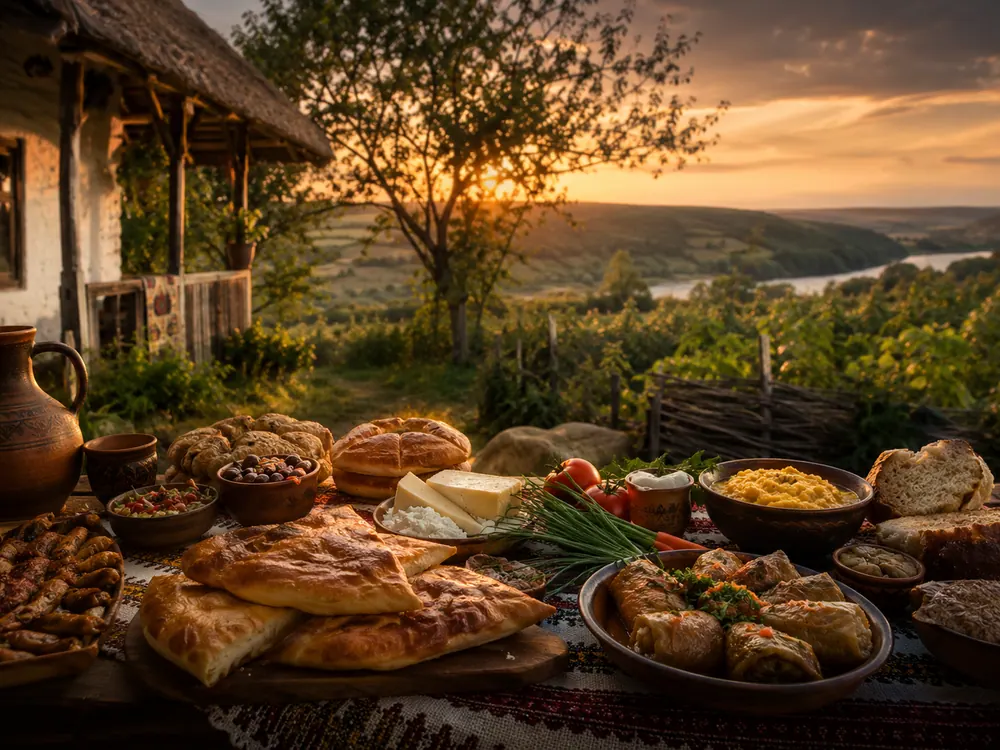
The core of the local table: plăcinte (filled pastries) with various fillings, sarmale, mămăligă (polenta) with cheese and sour cream, grilled meats, soups. It is a cuisine built around the long table and homemade wine.
It works best in the evening and in company. At lunchtime, between two sights, it is a difficult choice — it slows you down. The full background is in the food and drink section.
Gagauz
The cooking of the Turkic community in the south of the country, with a profile distinct from the Moldovan. It is a cuisine of the steppe and of mutton. If you are not getting to Comrat, Chișinău is where you can try it. The regional background is in the territory section.
Italian
Heavily represented, especially in the centre. That is no accident: it is the category the city eats every day. Useful when travelling with children, or when you have already had three traditional meals in a row.
Steakhouse
Present at the upper end of the centre. The category that pairs best with the local red wines — and the best fit for dinner after a day of tastings, if you want to continue with reds from the winery directory.
Speciality cafés
Chișinău has a genuine speciality coffee scene, concentrated in the centre. Useful at 9am, when the restaurants are still shut and you have a tour at 11.
How to plan your meals day by day
First evening: the centre, on foot, traditional Moldovan. You need the culinary context before anything else.
Excursion days: breakfast in the centre, lunch at the destination — check in advance, since outside the city the options drop off sharply — a light dinner on your return. See the day trips.
Your free day: get out of the centre. Botanica or Rîșcani, a neighbourhood place, no booking.
Last evening: somewhere specific, booked in advance. Telecentru for the view, or a landmark address in the centre.
Practical rules
- Book for the evening, at weekends, in the centre. The good places fill up.
- Lunch is cheaper. Many places do a set lunch on weekdays.
- Check whether cards are accepted. In the centre, almost everywhere. On the outskirts and outside the city, less certain. Details in the practical guide.
- House wine is a separate category. It is not winery wine and should not be judged as such.
- Do not eat heavily before a tasting. But do not go on an empty stomach either.
More on the city in the Chișinău section, and the calendar of events that affects table availability — especially in October — in news. We connect readers with restaurants and operators through our partners page; we do not take bookings.